
Holladay, Utah
ADUs in Holladay: Working From the Current Rules
Holladay rewrote its ADU ordinance in November 2024, and several of the city's own pages have not caught up. Start from the adopted text, then measure the lot.
If you looked into an ADU in Holladay a few years ago and were told you needed half an acre, that answer is out of date. The City Council adopted a new ADU ordinance on November 7, 2024, by unanimous vote, and it removed the old minimum lot size for detached units. Parts of the city's website and some application forms still describe the 2021 rules: the half-acre minimum, a 20 foot height limit and an added setback. That mismatch is the first thing we sort out for any Holladay property.
We work with homeowners in Holladay from the adopted ordinance text, and we confirm open points with Community and Economic Development (CED) before design.
Where the opportunity is in Holladay
Under the 2024 ordinance, ADUs may be established on a parcel with a single-family detached home in all residential zones, as long as the standards are met. They are not allowed with attached multi-family structures. The use table lists ADUs as permitted when accessory to a detached single-family dwelling, and the city says external ADUs can now go on any residential lot with a single-family detached structure.
ADU types Holladay recognizes
- Internal ADU (IADU): inside the home, or, per the city's ADU checklist, within its footprint or conditioned space or sharing a wall with it. Basements and attached additions fall here. Egress windows are required for existing and new construction. See basement ADUs.
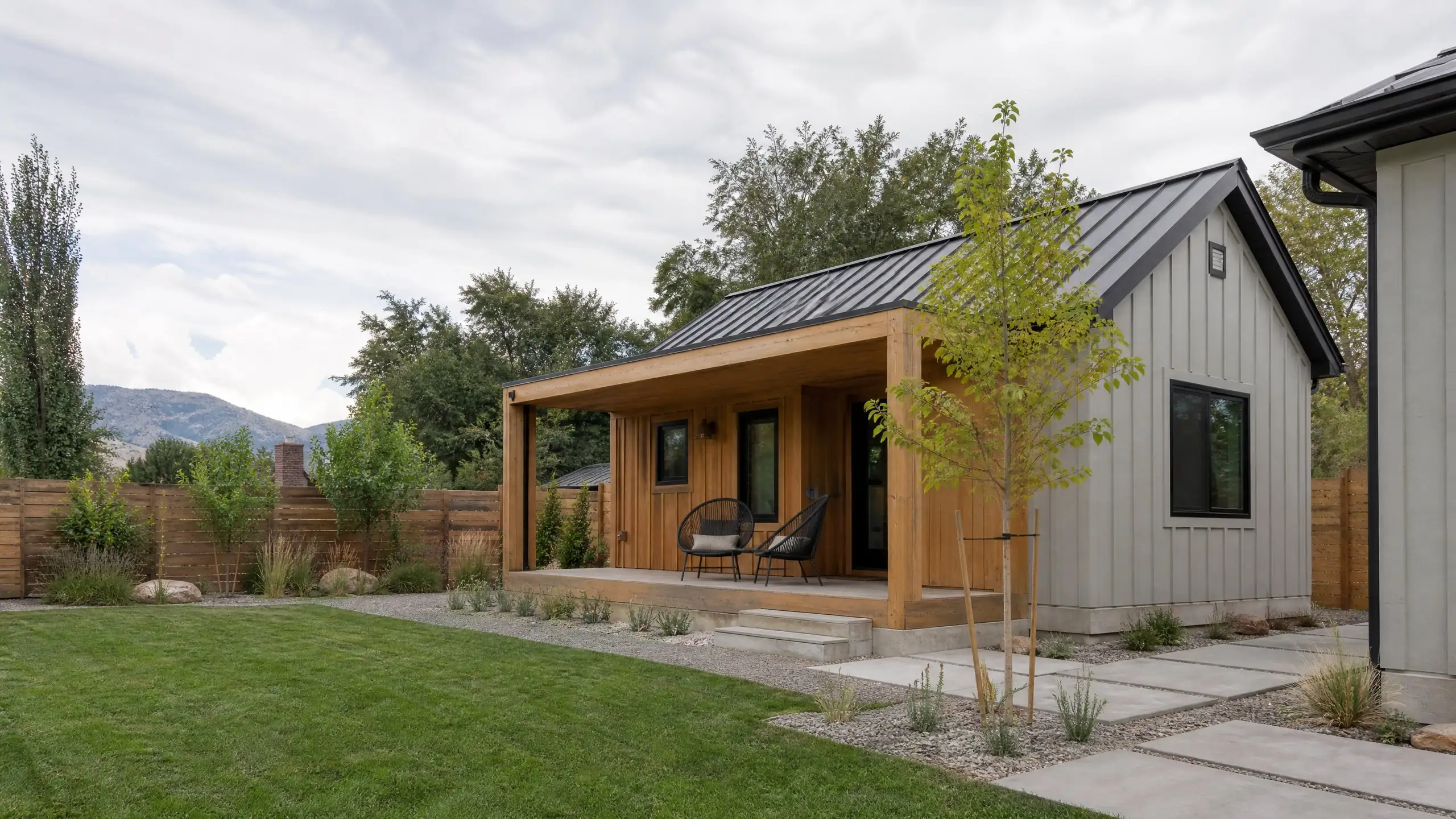
- External ADU (EADU): a separate, detached building. See detached ADUs and backyard ADUs.
- Converted accessory building: existing garages and accessory buildings, including non-conforming ones, may be converted with standards. An existing structure larger than the chart allows needs a conditional use permit for the extra footprint. See garage conversion ADUs.
Because a family member can satisfy owner occupancy, Holladay's rules suit in-law ADUs and multigenerational living well.
How big a detached ADU can be
Holladay scales the detached footprint to the lot, using its accessory building chart (13.14.101):
| Lot size (sq ft) | Total footprint (sq ft) | No closer than (ft) |
|---|---|---|
| Less than 8,000 | 800 | 3 |
| 8,001 to 14,600 | 850 | 4 |
| 14,601 to 21,200 | 900 | 5 |
| 21,201 to 27,800 | 950 | 6 |
| 27,801 to 34,400 | 1,000 | 7 |
| 34,401 to 41,000 | 1,050 | 8 |
| 41,001 to 47,600 | 1,100 | 9 |
| 47,601 to 54,200 | 1,150 | 10 |
| 54,201 to 60,800 | 1,200 | 11 |
| 60,801 to 67,400 | 1,250 | 12 |
| 67,401 to 74,000 | 1,300 | 13 |
| 74,001 to 80,600 | 1,350 | 14 |
| Over 80,600 | 1,400 | 15 |
The minimum EADU footprint is 200 square feet. Height is capped at 25 feet above existing grade, which the city says accommodates a pitched roof over a detached garage, and the unit must also meet the city's graduated height standards. The "total footprint" column is the accessory building limit, so on a lot that already has a garage or shed we ask CED how it is counted before sizing the ADU.
Lot and site considerations
Setbacks follow the accessory building rules, but Holladay lets owners reduce them in exchange for features that protect neighbors, never closer than the "no closer than" distance above. Examples from the reduction chart: a single-story structure with walls no higher than 10 feet earns 50 percent; an 8 foot masonry wall earns 50 percent; below-grade living space only earns 100 percent; and coordinating with a neighbor to build adjacent ADUs earns 100 percent. The owner files a signed agreement with CED describing the treatment and resulting setback.
The EADU must also meet the zone's lot coverage limits. The ordinance also sets dark-sky lighting standards for external ADUs, and doors, windows and patios cannot open into a required setback. Properties in a floodplain, fault zone or high liquefaction area need a natural hazard clearance. See ADU setback requirements and ADU design.
Holladay rules and permitting
- Owner occupancy: the owner or an immediate family member must live in the house or the ADU. Occupants of the ADU are limited to a single family, which can include up to four unrelated people.
- Parking: one on-site stall above the base requirement, plus replacement of any garage or carport spaces lost to a conversion. An ADU outside the home's existing footprint follows the bedroom-based parking minimums. The city says a second driveway needs a circular connection with 35 feet between entrances.
- Rentals: if rented, for at least 30 consecutive days, under an annual ADU license. The fee is set in the city's consolidated fee schedule.
- Utilities and address: no separate meters from the main house; the address is the main address plus "Unit B"; no ADU on a property with a failing septic tank.
- Permits: a building permit and certificate of occupancy are required, applied for through the Building Division's iWorQ portal with its building permit checklist and zoning worksheet, plus a notarized property ownership affidavit.
Utility considerations
Holladay lists three water providers (Salt Lake City Public Utilities, Jordan Valley Water Conservancy District and Holliday Water Co.) and two sewer providers (Mt. Olympus Improvement District and Cottonwood Improvement District), without saying which serves where. We identify the providers by address. Where Mt. Olympus provides sewer, its adopted 2026 schedule adds one residential equivalent and one capacity fee for a property with an ADU: $30 per month and a $758 capacity fee in 2026. Other providers' ADU fees we confirm case by case. See ADU sewer and water.
A typical Holladay ADU process
Feasibility against the current ordinance; a lot survey and footprint check; design with any setback reductions planned in; engineering; the building permit with the ownership affidavit and any setback agreement; construction and inspection; then the certificate of occupancy and, if you will rent, the ADU license. Our process explains each stage, and ADU permitting covers how we coordinate the applications.
Cost factors
In Holladay the local drivers include which sewer and water providers serve the lot and their fees, the walls, fencing or construction upgrades used to earn a setback reduction, dark-sky lighting, work to bring an older accessory building up to code, and any hazard reports. Unit type, size and finishes still dominate. See the Utah ADU cost guide.
To get a straight answer for your lot, See What Your Property Can Support.
Questions from Holladay homeowners
Do I still need half an acre for a detached ADU in Holladay?
No. That requirement came from the city's 2021 rules and was removed by the ordinance adopted November 7, 2024. The city now says external ADUs can be added to any residential lot with a single-family detached structure. Some city web pages and forms still show the old rule, so rely on the adopted ordinance and confirm with Community and Economic Development.
How big can a detached ADU be in Holladay?
It depends on the lot. The maximum footprint comes from the city's accessory building chart, starting at 800 square feet on lots under 8,000 square feet and rising in steps to 1,400 square feet on lots over 80,600 square feet. The minimum footprint is 200 square feet. The chart describes total accessory footprint, so ask the city how an existing garage or shed is counted.
Can my adult child live on the property instead of me?
Yes, under the current ordinance. The owner or an immediate family member (spouse, parent, child, sibling, grandparent or grandchild) must live in the main house or the ADU. There is also an exception for a temporary absence of up to three years for reasons such as military service or a job assignment, if the owner lived there before and returns.
Is Holladay changing its ADU rules again?
Possibly. On September 15, 2026 the Planning Commission held a hearing on amendments to align the ADU chapter with the new state detached ADU law, which took effect October 1, 2026. The draft changes parking and design standards. As of our review, the City Council had not adopted them, so they are not in force.