
Approvals
ADU Permitting
An ADU usually needs more than one approval: the city's sign-off that the unit is allowed, a building permit for the work, and often documents recorded on the property. We prepare and manage them. The city makes the decisions.
The layers of an ADU approval
Most homeowners expect one permit. In practice an ADU passes through several reviews, each with its own forms and its own reviewer. The names differ from city to city, but the layers are similar.
Knowing the layers early avoids the most common delay: finding out about a required document after the building permit is already in review.
- Land use approval: the city confirms the ADU is allowed on this lot and meets its ADU standards
- Building permit: plans reviewed for building, fire and energy code, often with engineering
- Utility confirmations: water and sewer providers confirm they can serve the unit
- Owner documents: affidavits, recorded notices or covenants
- Inspections and sign-off: each stage inspected, then final approval to occupy
- Rental license: required in many cities before the unit is rented
Who this service is for
Homeowners building any type of ADU who would rather not assemble site plans, affidavits, utility letters and code drawings themselves, and anyone who has started an application and hit review comments they are not sure how to answer.
How the approval route differs by city
Every city in Salt Lake County writes its own ADU process. The table summarizes the approval route in current code and city documents:
| City | Land use approval | Worth knowing |
|---|---|---|
| Millcreek | ADU application to Planning & Zoning, decided by the Planning Director, before the building permit | New detached ADUs also need site plan review; a notice of compliance is recorded |
| Salt Lake City | ADUs are a permitted use; the building permit carries the review | A zoning certificate comes before the certificate of occupancy; a restrictive covenant is recorded |
| Murray | Administrative ADU permit from the Planning Division | A separate building permit follows; the owner occupancy affidavit is recorded with the county |
| South Salt Lake | ADU predevelopment application, processed before the building permit | The owner affidavit must be recorded before a building permit or business license is approved |
| Sandy | Administrative special use permit plus a business license | Construction needs a separate building permit; the approval is recorded with the county |
| Cottonwood Heights | Internal ADUs permitted; detached ADUs a conditional use | Detached ADUs go to a Planning Commission public hearing; the ADU license is renewed yearly |
| Holladay | Building permit and certificate of occupancy for the ADU | A rented ADU needs an annual license |
| Unincorporated county | ADU application through the Municipal Services District | Written confirmation from the water supplier before a building permit |
For Millcreek specifics, see Millcreek ADU rules and Millcreek ADU permits. The general step-by-step is on ADU permit process.
Rules that are changing
A new state law, Utah Code 10-21-304, took effect October 1, 2026. It requires qualifying cities to permit detached ADUs on lots of 11,000 square feet or more that hold a single-family home, and bars them from requiring a conditional use permit for a detached ADU in a primarily residential zone. Sandy adopted new detached ADU rules on September 15, 2026 ahead of it. Cities may update their processes after that date, so we check the current code for every application. See Utah ADU laws.
Property considerations before applying
Most permitting problems start before the application. A setback measured from the wrong line, a missing parking space or an owner occupancy requirement nobody mentioned can send a set of plans back to the start. That is why our work starts with a feasibility review against the current code, and why we confirm unclear rules with city planners in writing before design is final.
What we prepare and manage
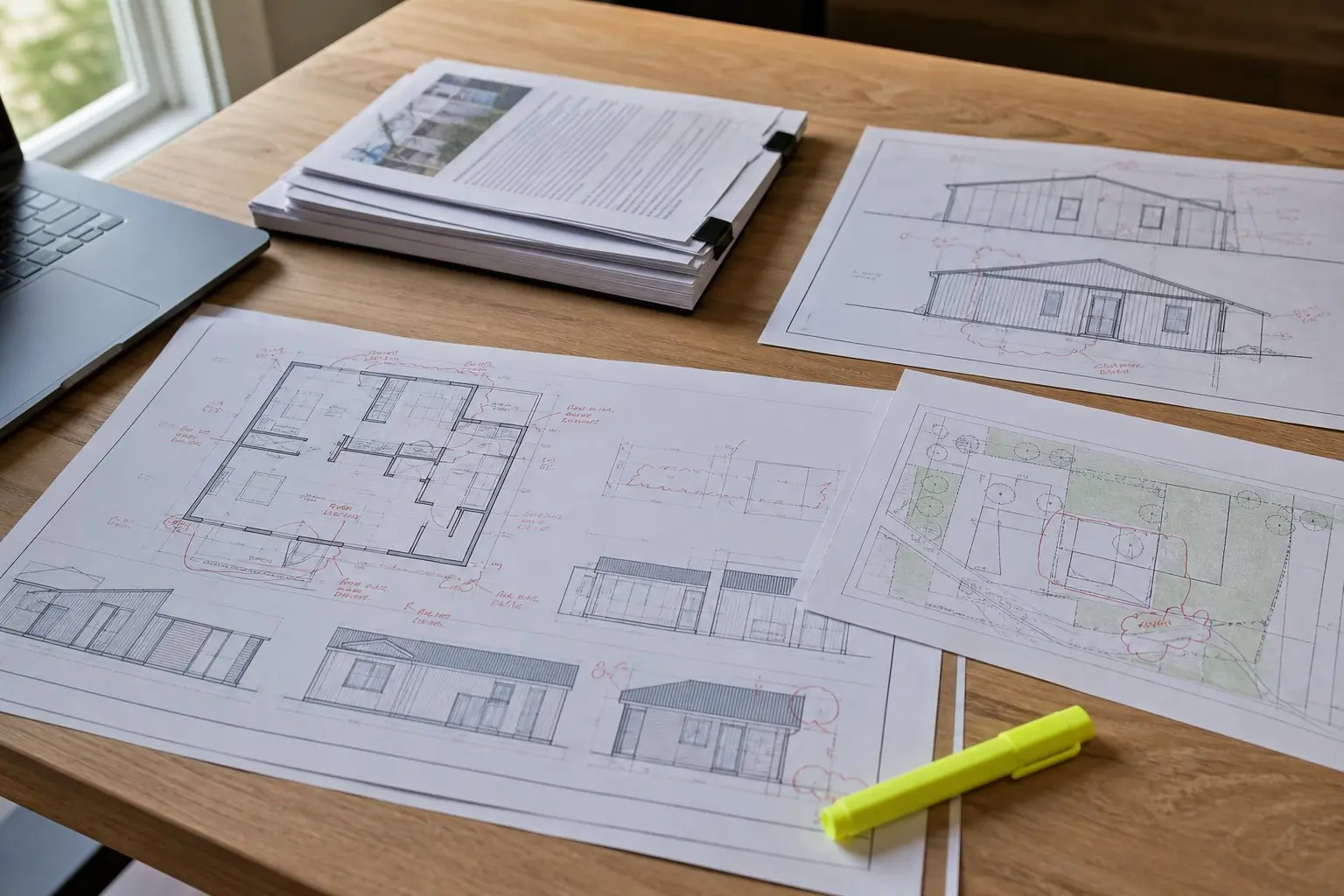
- The land use application: site plan, floor plans, elevations and the project narrative your city asks for.
- Building permit drawings, coordinated with structural engineering where it is required.
- Requests for water and sewer availability letters from the right providers for your address. See ADU sewer and water.
- The owner documents, prepared for your review and signature.
- Responses to plan review comments, with revised drawings.
- Inspection scheduling during construction, through final sign-off.
We cannot promise approval or a review date. We can make sure the city receives a complete, accurate application and that comments get answered quickly.
Design and construction considerations
Permit drawings are only as good as the design behind them. The building code layer, including fire separation between units and egress from sleeping rooms, is designed in from the start, not added for plan review. See ADU building code. During construction, inspections happen at set stages, and work cannot be covered until it passes, so the schedule is built around them.
Cost factors
Permitting costs include city application and permit fees, plan review, utility connection or impact fees where they apply, engineering, surveys where a city requires them, and recording fees. Fees vary by city and change over time. Official fees we have confirmed are in the ADU cost guide.
After approval
Some obligations continue once the ADU is built: owner occupancy, rental licenses and, in some cities, annual inspections. Short-term rental bans are common. See ADU owner occupancy and ADU short-term rental rules.
Questions about ADU permits
Can you promise my ADU will be approved?
No, and nobody honestly can. Only the city decides. What we can do is check the property against the current rules before design, prepare complete applications, and respond to review comments promptly, which removes the most common reasons applications stall or get sent back.
Do I need a permit to convert my basement or garage into an ADU?
Yes. Creating a dwelling unit is a change of use, so it needs the city's ADU approval and a building permit even when little construction is involved. Several cities also inspect the space before the ADU can be used or rented.
Will my ADU need a public hearing?
In most cities we work in, no: Millcreek, Murray and Sandy decide ADU applications administratively, and Salt Lake City and South Salt Lake list ADUs as a permitted use. Cottonwood Heights is the exception for detached ADUs, which are currently a conditional use decided by the Planning Commission after a public hearing. A state law in effect since October 1, 2026 bars qualifying cities from requiring a conditional use permit for a detached ADU in a primarily residential zone.
What do I have to sign myself?
Anything that only an owner can attest to: owner occupancy affidavits, property owner affidavits and some recorded notices or covenants. We prepare the rest of the application package and explain each owner document before you sign it.
How long does ADU permitting take?
It depends on the city, the type of ADU, how complete the application is and how many rounds of review comments come back. Some cities publish a target for the first plan review, but that is not the same as an approval date. We set expectations for your specific project once we know the city and the scope.