
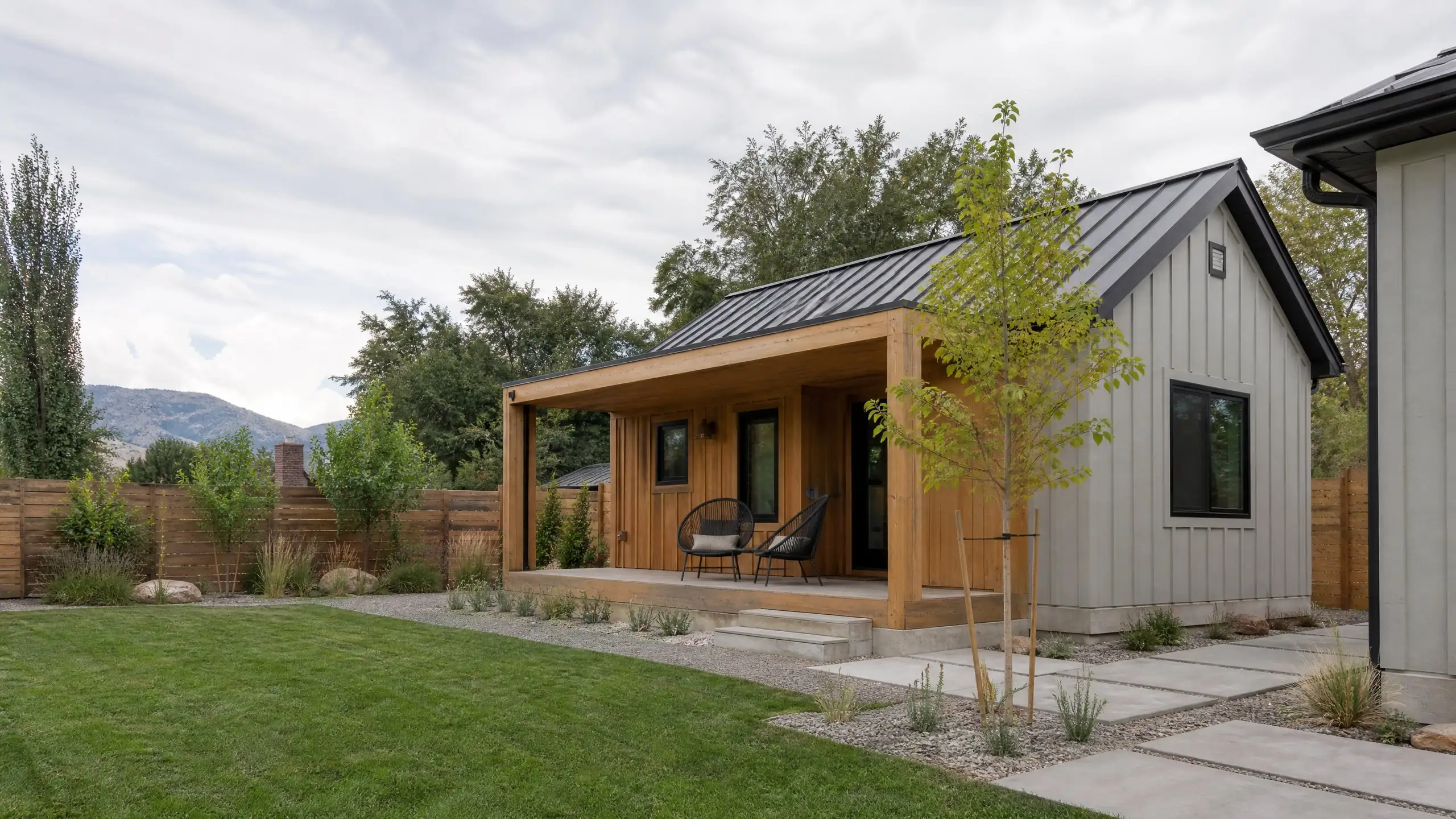
ADUs for family
Multigenerational ADUs
Two households, one lot, and a family plan that will change. The grown kids save for a house, the grandparents downsize, someone moves back, someone moves out. Build for all of it.
More than an in-law suite
A multigenerational ADU is a second home on the family's lot, planned for two related adult households living side by side for years. The people might be grown children and their partners, parents who want to downsize without leaving, siblings sharing a property, or grandparents helping with young grandchildren. Unlike an in-law ADU, it is not built around one person's needs. It is built around a household arrangement that will probably change.
Who lives where: three common arrangements
Adult child in the ADU
A grown child, perhaps with a partner, lives in the ADU while saving or starting a family. Priorities: their own entrance and parking, sound separation, a real kitchen, and enough storage for adult life.
Owners move to the ADU
Parents move into the smaller unit and hand the main house to a grown child's family. Priorities: single-level living, step-free access, and a unit that feels like a finished home, not a backyard room.
Grandparents helping out
Grandparents live on site to help with childcare. Priorities: a short, visible path between doors, a shared yard, and bedrooms placed away from the other household's noise.
Who this is for
Families who have already decided to live close and want it to work for everyone. It also suits families comparing an ADU with a larger house for everyone, an addition, or two separate homes. See building an ADU vs moving and ADU vs home addition.
Property considerations: the rules that shape family plans
One ADU per lot, usually. Millcreek, Murray, Sandy and Cottonwood Heights allow one ADU per lot. South Salt Lake allows one internal and one external ADU on the same lot.
The owner lives on the property. Most cities require the property owner to live in the main house or the ADU. Murray, South Salt Lake and Sandy allow either unit, which makes a later swap possible. Salt Lake City also counts a relative of someone on the deed as the owner occupant, and Holladay counts an immediate family member. Sandy requires the owner to be an individual or a family trust, not an LLC or similar entity, and its ADU permit ends when the property is sold or the primary occupant changes residence. See ADU owner occupancy.
The ADU stays with the house. Millcreek says an ADU may not be sold separately or subdivided from the main dwelling, and Salt Lake City, South Salt Lake and Sandy have similar rules. Family ownership plans have to work at the level of the whole property.
Occupancy limits. Millcreek caps attached and detached ADUs at two adults and any number of children. Holladay limits ADU occupants to a single family, which can include up to four unrelated people living as one housekeeping unit.
Design considerations for two adult households
- Separation first: separate entrances, separate outdoor spaces and good sound control, so closeness is a choice.
- Parking and storage: two working households mean more cars, bikes and gear. Most cities require at least one added off-street space for the ADU. See ADU parking requirements.
- Swap-ready layout: if the owners may move into the ADU later, design it now with step-free access and a bathroom that can take grab bars.
- A bedroom count that fits the city's limits and the family: see ADU size and layout and ADU floor plans.
- Shared spaces on purpose: a yard or patio both households use, placed so it does not sit outside someone's bedroom.
Shared costs and fair arrangements
Families pay for multigenerational ADUs in many ways, and the right one depends on who owns the property and who contributes. Two practical points help regardless. Utilities: most cities we work in prohibit separate meters for an ADU, so the bills arrive together. Millcreek's ADU page says secondary meters may be allowed to monitor usage, and Sandy may allow private meters behind the main meters. A separate heating system for the ADU makes a split simpler. Paperwork: agreements about contributions, use and what happens if plans change are worth writing down with professional advice. We plan and build; we do not give legal or tax advice.
Construction considerations
Two households need two sets of daily systems: water heating sized for both, electrical capacity for a second kitchen and laundry, and heating each household controls. If the main house is being updated at the same time, sequencing the two projects saves disruption. Most families keep living on site throughout, so we plan access, noise and utility shutoffs around both households.
Cost factors
The ADU type and the site drive most of the budget, followed by size, bedrooms and bathrooms, parking, utility capacity and finishes. Families often ask about longer horizons, such as whether the unit could become a long-term rental later. Most cities we work in ban short-term rentals in ADUs, so plan any future rental as long-term. See the ADU cost guide and ADU budget planning.
How we plan a multigenerational ADU
We start with the family's plan, including the likely changes, then check the property and the city's owner occupancy and occupancy rules, design for both households, prepare the applications, and manage construction through inspection.
Questions about multigenerational ADUs
How is a multigenerational ADU different from an in-law suite?
An in-law ADU is planned around one parent or couple and their accessibility needs. A multigenerational ADU is planned for two full households sharing a lot, often adults with jobs, cars and children of their own, and for the chance that who lives where will change over the years. The design priorities shift toward separation, parking, storage and shared costs.
Can we build two ADUs so three generations each have a home?
In most cities we work in, no. Millcreek, Murray, Sandy and Cottonwood Heights allow one ADU per lot. South Salt Lake allows one internal and one external ADU on the same lot. Check your own city before planning around a second unit.
Can my adult child buy the ADU from us?
Not as a separate property in most cities. Millcreek says an ADU may not be sold separately or subdivided from the main dwelling, and Salt Lake City, South Salt Lake and Sandy have similar rules, with Sandy allowing it only where zoning and subdivision standards are met. Families usually handle this through the ownership of the whole property, which is a question for a lawyer or financial adviser.
Can the owners move into the ADU and let the kids take the house?
In several cities, yes. Murray, South Salt Lake and Sandy allow the owner to live in either the main house or the ADU. Millcreek's code is not clear on which unit the owner must occupy, so confirm with the city before planning a swap there.
How do two households split the utility bills?
Most cities we work in prohibit a separate utility meter for an ADU, so both homes stay on the main account. Millcreek's ADU page says secondary meters may be allowed to monitor usage, and Sandy may allow private meters behind the main meters. Otherwise families agree a split, which is simpler if the ADU has its own heating system.