
Costs and decisions
Build an ADU or Move?
When a parent needs to be closer, an adult child needs a place to land, or the house no longer fits, there are two big options: change the property you have or find a different one.
The question usually arrives with a life change attached. A mother who should not live alone any more. A son back from school with no realistic way to rent nearby. A couple whose children have left, looking at a house that is now too big and a yard that could hold something smaller. Moving is the familiar answer to each of these. An ADU is the other one, and it deserves the same careful look.
Three common situations
Bringing a parent close
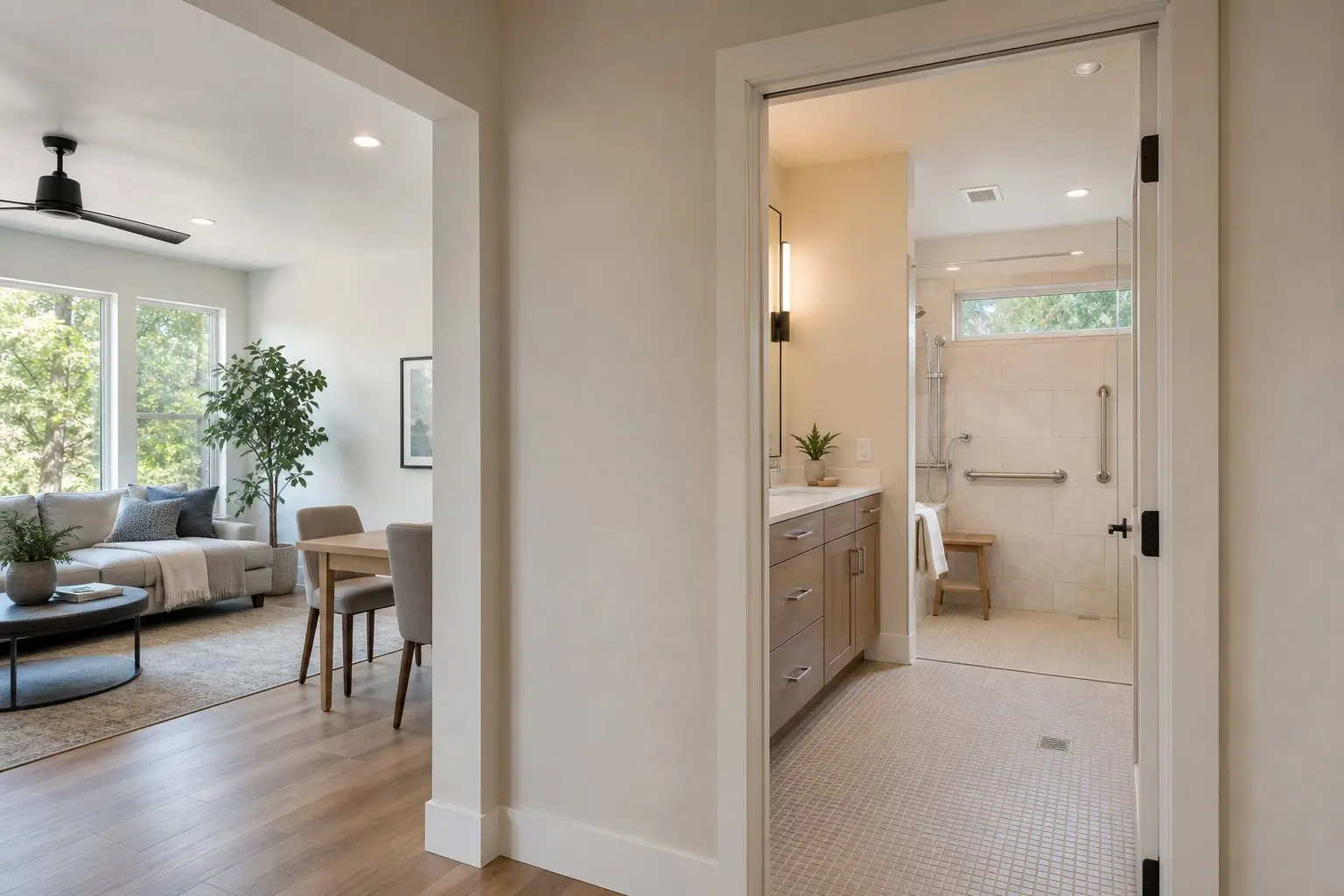
The choice is between a parent moving into your home, moving somewhere nearby, your household moving to a house that can hold everyone, or an ADU on your lot. An ADU lets a parent keep their own front door, kitchen and routine within a short walk of family. If the parent's needs may grow, design matters as much as location: a step-free entry, single-level living and a bathroom that works with a walker or wheelchair. See in-law ADUs.
Housing an adult child
For a grown child, an ADU can mean independence with lower housing costs, and for you, a unit that can later house a parent, a caregiver or a tenant. Moving to a bigger house solves the space problem but not the independence one. See multigenerational ADUs.
Downsizing in place
Some owners build an ADU to move into themselves, and let family or a tenant take the main house. That keeps the neighborhood, the doctor and the friends, while cutting the space you have to heat and clean. Whether the rules allow it depends on the city, and on who counts as the owner-occupant.
Compare the two paths honestly
| Question | Build an ADU | Move |
|---|---|---|
| What does it cost? | Design, fees, site work and construction, which depend heavily on the property | Selling and buying costs, moving, and changes to the new house |
| What changes day to day? | Construction at home for a period, then the same neighborhood | A new neighborhood, commute, schools and routines |
| Who decides the timing? | City review, utility providers, the construction schedule | The housing market, both for your sale and your purchase |
| What is uncertain? | Site conditions and approvals until they are checked | Finding the right house, at the right time, in the right place |
| What is left afterward? | A second home on your lot that can change use over time | A house that fits today's household |
Neither column is better in general. The point is to price and weigh both, not to compare the cost of building with a vague sense that moving is simpler. For the build side, our Utah ADU cost guide explains the drivers.
Rules that shape the family plan
ADU rules were mostly written with rentals in mind, but several of them matter just as much for family housing:
- Owner occupancy. Every city we cover requires the owner, or in some cities a relative, to live on the property. Salt Lake City counts a person related by blood, marriage or adoption to someone on the deed. Holladay counts an immediate family member, defined as a spouse, parent, child, sibling, grandparent or grandchild. Murray lets the owner occupy either the main unit or the ADU. See ADU owner occupancy.
- Who can live in the ADU. Millcreek limits attached and detached ADUs to 2 adults and any number of children. That suits a parent couple or a young family, but not three adults.
- One ADU per property. Millcreek's code says "No property may have more than one ADU," and Murray's says the same in its own words. If the long-term plan involves two extra households, an ADU alone will not do it.
- No separate sale. In Millcreek an ADU "shall not be sold separately or subdivided" from the main dwelling or property. It is part of the family home, not a second asset you can split off.
- Approvals tied to the owner. In Sandy, the ADU permit ends on a sale of the property or a change of residence and is not transferable to a new owner.
Questions to answer as a family
- Who will live in the ADU first, and who might live there in the long run?
- Does everyone want to live this close? Separate entrances and outdoor space help, but they do not settle this.
- Will the person in the ADU need accessibility features, now or later?
- Who owns the property, and does that satisfy your city's owner occupancy rule for the arrangement you have in mind?
- How will costs, utilities and upkeep be shared? Several cities here prohibit separate utility meters for an ADU.
- What happens if circumstances change: a parent needs more care, a child moves out, you decide to sell?
Finding out whether building is realistic
The ADU path only makes sense if the property can support the unit your family needs. Lot size, setbacks, utilities, parking and the existing house decide that, and they can be checked before anyone pays for plans. That is the first step in our feasibility review, and it gives you something concrete to set against the moving option. If you are weighing an addition instead, see ADU vs home addition.
Questions about building an ADU versus moving
Is building an ADU cheaper than buying a bigger house?
Sometimes, but the comparison is not only about price. Moving has its own costs: selling, buying, moving and often updating the new house. Building has design, permits, construction and a period of disruption at home. The useful comparison sets the full cost of each path side by side, along with what each gives your family.
Can I move into the ADU and let my family have the main house?
In some cities the rules clearly allow it. Murray's code says the owner may occupy either the main unit or the ADU, and Holladay allows the owner or an immediate family member to live in either. Millcreek's code does not clearly say which unit the owner must live in, so confirm with the city before planning around it.
Can a parent live in an ADU on my property if I am not the owner living there?
Owner occupancy rules usually require the property owner, or in some cities a relative, to live on the property. Salt Lake City counts a person related by blood, marriage or adoption to someone on the deed, and Holladay counts an immediate family member. Other cities require the owner. Check your city's exact wording.
What happens to the ADU if we sell later?
It stays with the property; it cannot be sold on its own. In some cities the approval is tied to the owner: Sandy's ADU permit ends on a sale and is not transferable, so a buyer would need to apply again to use it as an ADU.