
ADU types
Internal ADUs
Utah law treats one kind of ADU differently from all the others: a separate home created inside the house you already live in. Here is what that protection covers, and what building one takes.
The state's three-part test
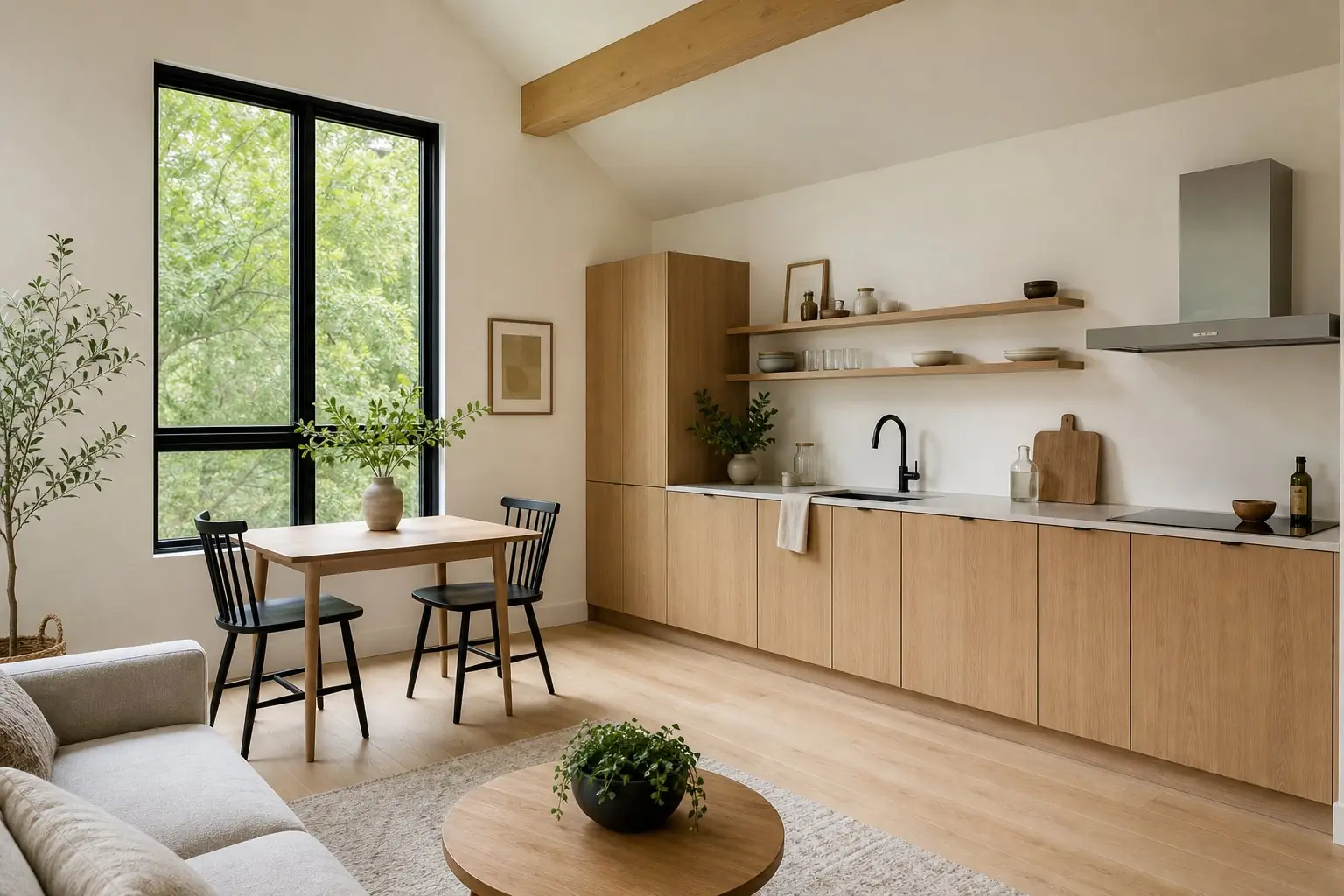
An internal ADU is part of a house, such as an upper floor, a wing, a basement or a connected garage, turned into a complete separate dwelling with its own entrance, kitchen, bathroom and sleeping area.
Utah Code 10-21-101 defines the internal accessory dwelling unit, or IADU, with three conditions. Meeting all three puts the unit under Utah Code 10-21-303 for cities (17-80-303 for unincorporated county areas).
- Withina primary dwelling: a detached single-family home occupied as the owner of record's primary residence
- Inside the footprintof that dwelling at the time the IADU is created
- For long-term rentalof 30 consecutive days or longer
What cities must allow
Under Utah Code 10-21-303, in any area zoned primarily for residential use, an internal ADU is a permitted use. Apart from the restrictions the statute lists, a city may not set restrictions or requirements for one internal ADU within a primary dwelling, including rules on its size relative to the house, total lot size, street frontage or internal connectivity. Architectural rules must be consistent with those for single-family homes. And the unit must comply with all applicable building, health and fire codes.
What cities may restrict
The statute gives cities a specific list of options. A city may:
- prohibit a separate utility meter;
- require that the IADU not change the house's appearance as a single-family dwelling;
- require one additional on-site parking space, unless the city already requires four off-street spaces, and require replacement of garage or carport parking used for the IADU;
- prohibit an IADU in a mobile home, or where the house is served by a failing septic tank;
- prohibit an IADU on a lot of 6,000 square feet or less;
- require a permit or license to rent it;
- prohibit renting it for less than 30 consecutive days, or renting it when the owner does not live in the house as a primary residence;
- prohibit IADUs in zoning districts covering 25 percent or less of the city's residential area, with limits on how that applies to newer homes;
- record a notice on the property, and place a lien for uncured violations after written notice.
How nearby cities use those options
| City | Lot size | Parking | Worth knowing |
|---|---|---|---|
| Millcreek | No added lot rule in its internal ADU standards | 1 stall per ADU | Adds only three rules: unchanged appearance, no separate meters, no mobile or manufactured homes |
| Salt Lake City | No minimum lot size for an ADU | 1 stall, waived near transit or a city bike lane or path | No maximum floor area for internal ADUs |
| Murray | None stated for attached and internal ADUs | 3 off-street spaces in total | No maximum floor area |
| South Salt Lake | 6,000 sq ft and 50 ft wide | 1 added, at least 3 in total | Needs an exterior entrance with weather protection |
| Cottonwood Heights | More than 6,000 sq ft | 1 added, at least 3 in total, no tandem | Annual ADU license and inspection |
| Unincorporated county | 6,000 sq ft or more | At least 1 on-site space | No separate HVAC or firewall required |
For full city summaries, see our Salt Lake County overview and Millcreek ADU rules. Owner occupancy details are on ADU owner occupancy.
Fees, HOAs and rentals
Impact fees: Utah Code 11-36a-202 bars impact fees on building an internal ADU within an existing primary dwelling. Permit and other fees still apply. HOAs: an HOA rule may not prohibit an owner from building an internal ADU on their lot unless it would break a land use ordinance or a building, health or fire code (57-8a-218). The state HOA office reads this as covering CC&Rs as well; the statute's wording refers to rules. See ADU HOA rules. Short-term rentals: cities may ban IADU rentals under 30 consecutive days. See ADU short-term rental rules.
Which parts of a house can become one
Any part of the house that can be separated cleanly: a basement, an upper floor with its own stair, a bedroom wing at one end of a ranch house, or an attached garage converted to habitable space. The best candidates share three traits: a place for a private entrance, a practical route for a new drain line, and a layout that leaves the main house fully usable.
Who an internal ADU suits
Owners with more house than they need, owners who want the lowest-construction path to a long-term rental, and families who want a relative close by under one roof. Because the owner must live in the house for the state framework to apply, it suits people planning to stay.
Design and construction considerations
- Separation: the walls and floors between the two units are built for fire separation and sound control as the building code requires. Utah amended the International Residential Code for ADUs in Utah Code 15A-3-202.
- Entrance: a private door, usually at the side or rear so the house still reads as one home.
- Kitchen and bath: new drain lines, ventilation and electrical circuits.
- Mechanical and electrical: Utah's amendments say an ADU occupant is not required to have access to the disconnect serving their unit, which gives some flexibility on panel location. Separate heating is often worth it for comfort.
- One meter: in most cities the ADU stays on the house's utility meters, so plan how costs are shared.
See ADU building code for the code layer.
Cost factors
Internal ADUs are usually the least construction-heavy type. The drivers are the new entrance, plumbing routes, fire and sound separation, electrical capacity, heating, kitchen and bathroom finishes, and any egress work. Compare in the ADU cost guide.
How an internal ADU project runs
We confirm the house meets the state test and your city's options, measure the space, design the separation and layout, prepare the city's ADU application and building permit, and manage the work while you live in the house. The full process covers each step. Comparing options? Read detached vs internal ADUs.
Questions about internal ADUs
What is an IADU?
IADU is short for internal accessory dwelling unit. Under Utah law it is an ADU created within a primary dwelling, within the footprint of that dwelling at the time it is created, for the purpose of offering a long-term rental of 30 consecutive days or longer. The primary dwelling must be a detached single-family home occupied as the owner's primary residence.
Can my city say no to an internal ADU?
In areas zoned primarily for residential use, state law makes an internal ADU a permitted use. Cities can still apply the specific restrictions the statute allows, such as prohibiting one on a lot of 6,000 square feet or less, requiring an added parking space, or requiring owner occupancy before renting. The unit must also meet building, health and fire codes.
Does converting my attached garage count as an internal ADU?
It can. Utah's definition of a primary dwelling includes a garage that is habitable space and connected to the house by a common wall. Cities may require you to replace the garage parking you lose.
Can my HOA stop me from building an internal ADU?
Utah law says an HOA rule may not prohibit an owner from building an internal ADU on their lot, unless it would violate a land use ordinance or a building, health or fire code. The state HOA office says this includes CC&Rs, but the statute's wording refers to rules, so talk to the association and, if needed, a lawyer before relying on it.
Can I rent an internal ADU on Airbnb?
State law lets cities prohibit renting an internal ADU for less than 30 consecutive days, and many do. Salt Lake City, Murray, South Salt Lake and Cottonwood Heights ban short-term rental of ADUs. Plan an internal ADU as a long-term home.